

Struggling with Traffic?Cracking Shopify SEO with must know hacks!
Most Shopify stores fail due to poor SEO optimization and trust me you are not alone.
Industry data suggests that a staggering 90% to 95% of Shopify stores fail to achieve long-term profitability, with a significant portion of this failure attributed to a lack of traffic resulting from poor or missing SEO (Search Engine Optimization) strategies.They try every tactic but make the mistake of chasing shortcuts.
While the platform is easy to use, the "build it and they will come" mentality leads many new store owners to neglect organic search visibility, causing their stores to struggle to break even. Industry data also indicates that 80-90% of Shopify stores fail within their first year itself .
Your Shopify Store Should Be Selling, Not Hiding
Let’s be honest:In today’s competitive digital landscape, just having a Shopify store isn’t enough. Without proper SEO, your store won’t rank & generate sales.
By pouring your heart into your DTC brand only to be ignored by Google is incredibly frustrating. If your Shopify store feels like a ghost town and you’re tired of burning your budget on ads that just aren’t hitting, you’re definitely not alone. Scaling organic traffic often feels like the ultimate uphill battle.
Whether you’re selling skincare or home essentials, it’s time to move past the basics and aim for top-tier rankings. We’re skipping the fluff and diving into the SEO hacks that actually move the needle. Ready to stop being "page 10 famous" and start seeing your sales grow? Let’s get into it.
What is Shopify SEO?
Think of Shopify SEO as the digital version of "location." You could have the most aesthetic storefront in the world, but if you’re tucked away in a dark alley where no one can find you, your sales are going to stay at zero.
In technical terms, it’s the process of optimizing your site structure, product descriptions, and backend settings to tell Google exactly what you sell. But in "founder terms"? It’s the art of making sure when someone types "best [your product category]" into a search bar, your brand is the first thing they see.
By mastering ecommerce SEO, you aren't just chasing "likes"—oyed you're building a sustainable machine that brings in organic traffic 24/7. It’s about moving from being a hidden gem to a household name, without having to pay for every single click.From keywords to conversions, Shopify SEO optimization covers every corner of your store.
Frequently asked questions-
- Why is my Shopify store not ranking on Google?
- Why is my Shopify store getting low organic traffic but high ad spend?
- Why are my Shopify product pages not appearing in Google search results?
- Why is my Shopify store not showing in local SEO results ?
- Why is my Shopify store getting traffic but not converting?
Most of the time, it boils down to poor Shopify SEO management. If your backend is a mess of unoptimized images and generic descriptions, Google simply can't find you, leaving your amazing products buried where no one can see them.
Why It Matters
Why Shopify SEO Really Matters
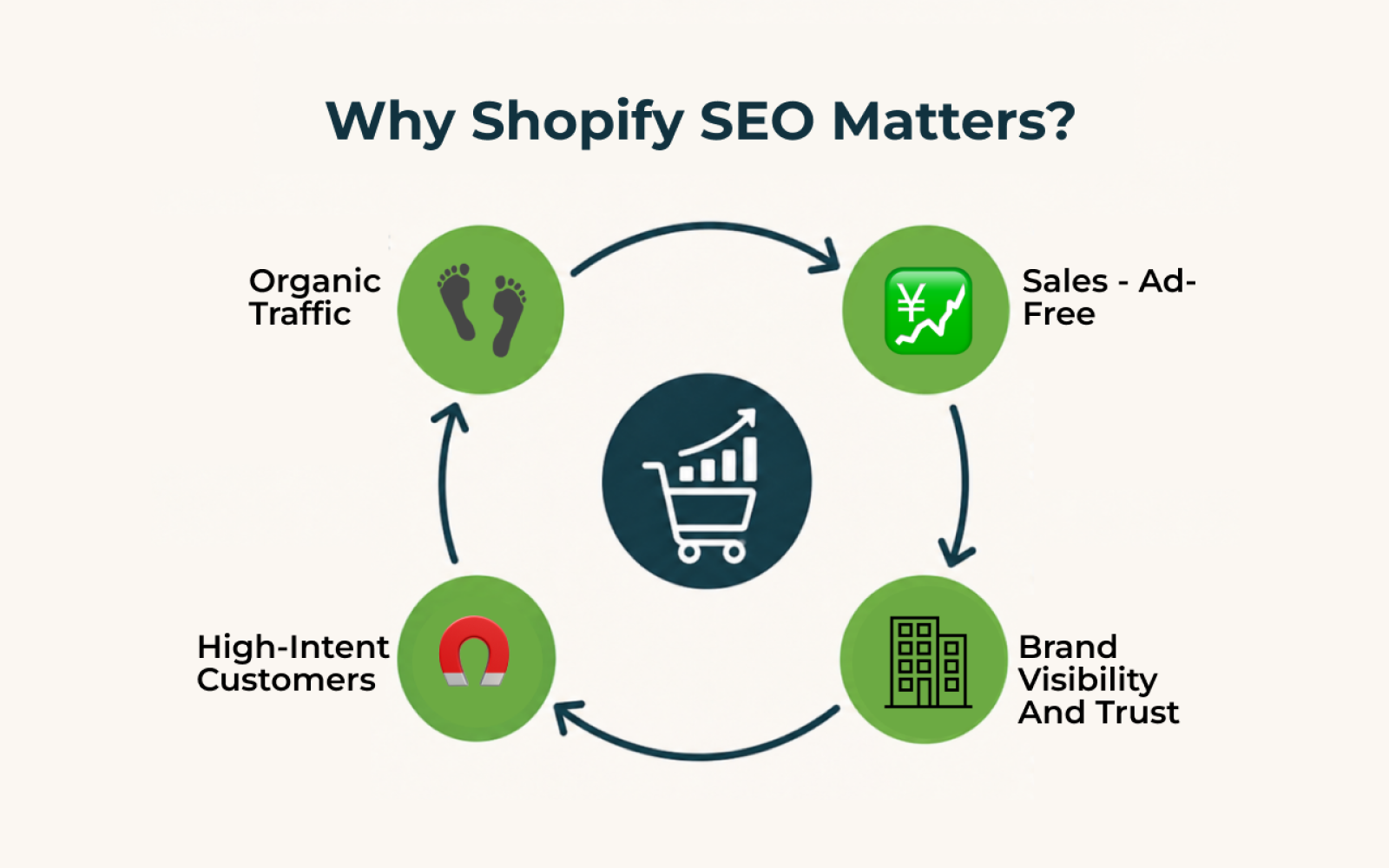
- It brings consistent organic traffic
Instead of depending only on ads, SEO helps your store get discovered naturally on Google—again and again. - It increases sales without burning ad budget
Paid ads stop the moment you stop spending. SEO keeps working in the background, bringing in potential buyers 24/7. - It builds your brand visibility and trust
When your store shows up on the first page of Google, people automatically see you as more reliable and established. - It attracts high-intent customers
You’re not just getting visitors—you’re reaching people who are already searching for products like yours and are ready to buy.
What Makes Shopify SEO a Game-Changer
- You stop “renting” your traffic Ads are temporary. SEO is long-term. Once you start ranking, your store keeps getting traffic without paying for every click.
- You reach the right audience at the right time With the right keywords, your store appears exactly when someone is searching with intent—like “best organic supplements” or “affordable skincare products.”
- You build instant credibility People trust Google. If you rank higher, they trust you more—and that directly impacts conversions.
- You can compete with bigger brands Even if you don’t have a massive budget, smart SEO (especially on product and collection pages) can help you outrank larger competitors in your niche.
Why Your Shopify SEO is Probably Flopping (and How to Fix It)
Look, driving real growth isn't about luck; it’s about dodging major traps that kill most Shopify stores before they even get off the ground. A lot of Shopify store owners unknowingly make SEO mistakes—not because they don’t care, but because they assume once the store is set up, the job is done. That “set it and forget it” mindset, along with a lack of technical clarity, often leads to poor rankings, low organic traffic, and heavy dependence on paid ads.
Here’s the "no-fluff" breakdown of why things go south.Let’s break down the most common mistakes that quietly hold your store back:
1. The "Square Peg, Round Hole" Strategy
The biggest mistake? Hiring a "Fashion Agency" just because you sell clothes. It doesn’t matter what you sell; it matters how many things you sell. A brand with five deodorants needs a totally different playbook than a boutique with 10,000 items. If your agency is giving you blog posts when you actually have a massive catalog organization (taxonomy) problem, you’re essentially bringing a knife to a gunfight.
2. Merchandising Chaos
SEO loves stability; startups love moving fast. If you’re constantly deleting collections, renaming pages, or letting core products go "404 Not Found," you’re resetting your progress every single week. You need a workflow that keeps the shop fresh without breaking the links Google already likes.
3. The "Who's in Charge?" Gap
Marketing is messy. You’ve got an email person, a PPC person, and an SEO person—all shouting for budget. SEO touches everything (site speed, UX, content). If you don’t have a leader internally acting as the "conductor," these specialists will just clash, and your strategy will fall into a black hole.
4. Paying for "Free" Traffic
Ever feel like your paid ads are just "stealing" clicks your organic search would’ve gotten anyway? That’s cannibalization. If you don't understand how your channels overlap, you’ll end up paying Google for customers who were already walking through your front door for free.
5. The "Generalist Trap"
A lot of agencies claim they can do SEO for any platform. Big mistake. Shopify has specific quirks (like rigid URL structures and messy filters) that require custom fixes. Generalists spend their time and money "learning" the platform. Specialists already know which levers to pull to get an 80% success rate instead of 30%.
6. All Talk, No Action
The classic agency move: sending a 50-page PDF "audit" and then ghosting. Strategy is useless if it sits in your inbox. You need partners who act like engineers, not consultants—people who actually write the code, fix the site, and ship the assets instead of just giving you a homework assignment.
The Bottom Line: Growth fails when you apply a generic playbook to a complex business. Most of these mistakes aren’t complicated—they’re just overlooked. Fixing them can make a huge difference in how your store performs.Smart SEO Shopify is not just about ranking — it's about attracting the right audience, at the right time, with the right intent. Start by cleaning up duplicate content, improving your site speed, writing unique product descriptions, and making sure your redirects are in place. Small changes like these can turn your Shopify store from “hard to find” into “easy to rank.”
Stop "renting" your traffic and start building a stable, high-performance machine.We improve your Shopify SEO so your store attracts the right traffic, drives real conversions, and grows consistently over time.
Want Better Rankings? Here’s Where Your Shopify SEO Game Starts
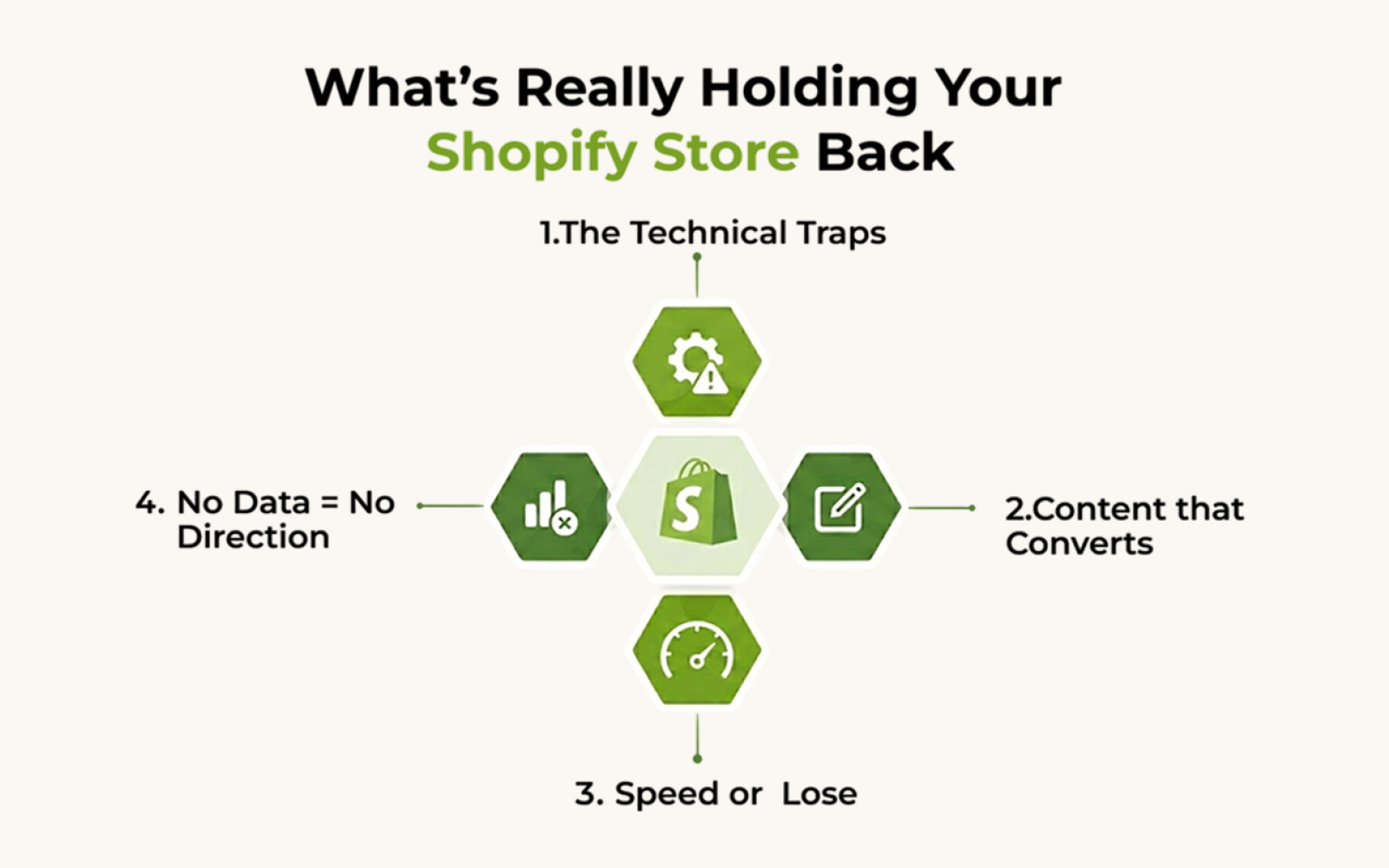
A lot of the time, the problem with Shopify SEO isn't that you're doing things "wrong"—it's that you might just be missing some of the sneaky, technical little things that Shopify does in the background.Improve SEO on Shopify the right way — with strategies that rank, convert, and scale. If you've ever thought, “Why am I not ranking higher?” it’s probably because you need to give some love to these four crucial areas:
1. Let's Talk About Technical Issues (They're Tricky!)
Think of technical SEO like your store's foundation. If the foundation is wobbly, nothing you build on top of it will ever be solid. Unfortunately, Shopify has some quirks:
- Duplicate Content Nightmare: Shopify loves creating multiple links for the same product. You might have /products/your-cool-shirt AND /collections/men/products/your-cool-shirt. Without setting proper "canonical tags" to tell Google which one is the real page, you're essentially confusing the algorithm about which page to rank.
- Limited Robots.txt Control: You can't fully control this tiny file, which means Google might waste time crawling pages that don’t matter (like your "Thank You" page) and miss the ones that do.
- Rigid URL Structure: You can't just make your URLs super clean and keyword-perfect (like /mens/shirts/blue). Shopify forces you into a specific layout (/collections/mens/products/blue-shirt), which isn't always ideal.
- The Dreaded "404" Errors: We've all seen them. You delete a product or change a URL but forget to set up a redirect. Boom. A broken link that gives a terrible user experience and makes Google unhappy.
2. Is Your Content Strategy... Actually Working?
You could have the most perfect, beautiful website in the world, but if your content doesn't connect, you won't rank. Period.
- Manufacturer Copypaste: Look, everyone knows it's easier to just copy the manufacturer's description. But if you do, your store just looks like every other shop selling that same product. Google has zero incentive to rank you over your competitors if your content is the same.
- Ignoring Title Tags and Meta Descriptions: Think of this as your website’s elevator pitch in search results. If they're missing or generic (like just saying "Blue Shirt"), people are going to scroll right past you.
- Skipping the Blog: Your blog is a massive opportunity to reach customers before they're even ready to buy. It's about answering questions, providing value, and showing Google that you are a real authority in your niche.
- Missing Image Alt Text: This is such an easy win. Alt text helps visually impaired users and helps Google understand what's in your photos, which can bring traffic from Google Images.
3. If Your Store is Slow, You're Already Losing
SEO isn't just about keywords; it's about the entire experience. If your store gives a bad user experience (UX), Google will penalize you.
- The "App Bloat" is Real: We get it—you want every single feature under the sun. But every single app you install adds extra code to your site, which slows it down. Site speed is a massive ranking factor, so a slow site is essentially a "Do Not Enter" sign for customers.
- Is Your Mobile Experience Smooth? Most of your customers are on their phones. If your site isn't smooth, responsive, and easy to navigate on a tiny screen, visitors will leave within seconds.
- Thin Collection Pages: Your collection pages are some of your biggest traffic drivers. If they're just a grid of products with zero description or helpful content, they’re not going to rank for broader, more popular keywords.
4. Stop Guessing, Start Tracking
Finally, you cannot improve what you cannot measure. Strategy and tracking are everything.
- Flying Blind Without Analytics: If you're not using tools like Google Analytics 4 (GA4) or Search Console, you're essentially guessing what’s working. You need data-driven insights to know which keywords and products are actually driving revenue.
- Ignoring Your Internal Links: Don't just rely on your navigation menu. Linking between your blog posts, product pages, and collections helps Google discover more of your content and spreads that valuable "link equity" around your site.
- International SEO Missteps: If you sell in multiple countries, you must use something called hreflang tags. It basically tells Google, "Hey, this page is for the US, and this page is for the UK," to ensure you show up in the right market.
- Google Search Console : Google Search Console for Shopify shows us exactly what Google sees — and we use that data to fix what's broken, spot what's working, and push your store straight to the top.
The right Shopify SEO tools and apps can transform your store from stagnant to scaling — faster than you think. See something you need help with? Don't sweat it.Work with a Shopify SEO expert whose decisions are backed by data, strategy, and a deep understanding of how Google works. We're Shopify specialists who can help you un-mess your technical issues, dial in your strategy, and finally start ranking where you belong. Let's chat!
Game Changing Hacks for your Shopify SEO
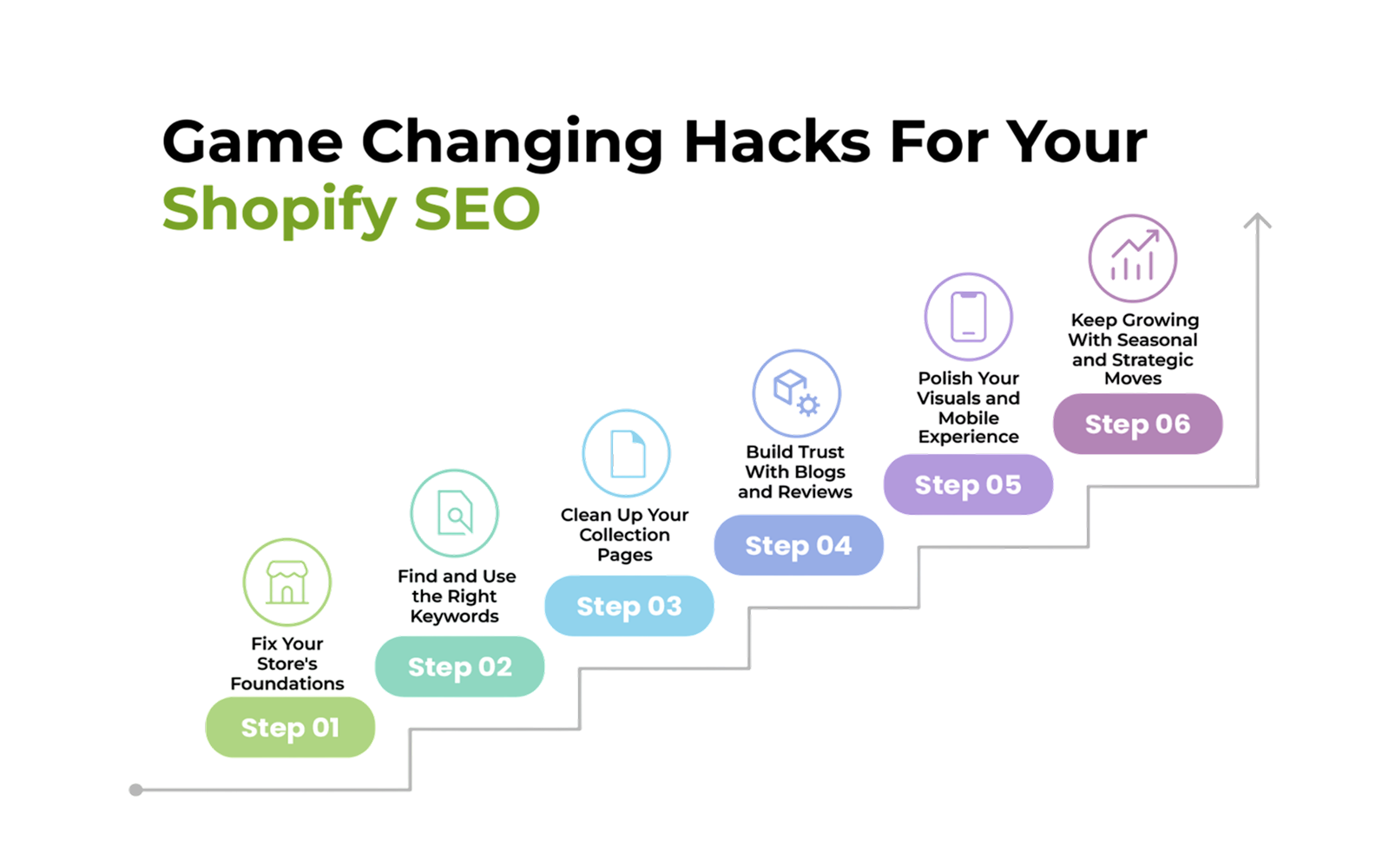
Alright, let’s get your Shopify store out of the "hidden alleyway" and onto the digital high street. We're going to keep it low-stress and high-impact. No coding, no jargon—just simple moves that Google loves.
Here is your "SEO Glow-Up" Planner ,to turn your store into a traffic magnet.
Step 1: Fix Your Store's Foundations
Walk through your store like a customer and click every link. Then do the following:Fix any 404 errors — if you deleted a product, make sure that link doesn't lead to a "Page Not Found." Set up a simple redirect in Shopify via Online Store > Navigation > URL Redirects. Next, go to your top 10 products, click each image, and add proper Alt Text. Don't just write "shirt" — write "Men's Slim Fit Navy Blue Linen Shirt." It helps Google "see" your photos. Finally, delete any Shopify apps you aren't using. They slow your store down, and page speed matters to Google.
Step 2: Find and Use the Right Keywords
Find the words your customers actually type into Google. Brainstorm 5–10 phrases like "affordable [your product]" or "best [your product] in the US." Then sprinkle these naturally into your Product Titles and Meta Descriptions — the gray preview text that shows up on Google. Also, rewrite at least one manufacturer product description in your own voice. Sounds like you're explaining it to a friend. Google penalises copy-pasted content.
Step 3: Clean Up Your Collection Pages
At the top of your "Best Sellers" or "Summer Collection" page, write 2–3 sentences describing what's there. Inside that text, link to one or two specific products. Think of it as a shop assistant pointing a customer to the right shelf — it helps both Google and your buyers navigate your store better.
Step 4: Build Trust With Blogs and Reviews
Write 2 blog posts that answer common customer questions, such as "How to style X" or "Why our Y is different." Then reach out to 5 past customers and ask for a review. Reviews are fresh, keyword-rich content that Google loves. Once your blogs are live, go back to your most popular one and add a "Shop the Look" section at the bottom to turn readers into buyers.
Step 5: Polish Your Visuals and Mobile Experience
Open your store on your phone. Is the "Add to Cart" button easy to tap? If not, adjust your theme settings. Before uploading any new images, rename the files descriptively — instead of IMG_1234.jpg, use handcrafted-leather-wallet.jpg. Also add a short 10-second video to your top product page. It keeps visitors on the page longer, and Google rewards that "dwell time."
Step 6: Keep Growing With Seasonal and Strategic Moves
Create a "Guide" collection — it's a magnet for search traffic. Check your Google Search Console to see which pages aren't getting clicks, and rewrite those page titles to be more compelling. Share your 3 best blog posts on Pinterest or Facebook to signal to Google that your store is active. Finally, at the end of the year, compare your traffic to 12 months ago, identify your top 5 winning keywords, and write one in-depth blog post around them.
Ready to start? Pick one action from Step 1 and knock it out today!
Don’t be a stranger! Still feeling a little ghosted by Google?
SEO is a marathon, not a sprint — and you need a Shopify SEO Agency that drives real sales. We're here to help you with smart Shopify SEO to cross the finish line. Whether you have a quick question or need a full-blown strategy session, we're always here to help. Drop us an email — let's turn your traffic around together.
Shopify SEO is not optional—it’s essential for long-term growth. By implementing the right strategies, you can drive consistent traffic and increase revenue.
Turning Your Store Into a Growth Engine
At the end of the day, Shopify SEO isn’t just about checking boxes or installing a random plugin—it’s about building a system that works for you while you sleep. Most stores stay stuck not because SEO is "too hard," but because it’s often rushed or shoved to the bottom of the to-do list. But now? You’ve got the roadmap to change that.
Whether you’re selling niche home goods or the next big beauty brand, the goal is the same: turning your store from "just another website" into a sales-generating machine. Remember, you don’t have to do it all by yourself. Whether you tackle it 20 minutes at a time or decide it’s time to call in the pros, the most important step is simply starting.
The sooner you begin optimizing, the faster you’ll build that "set it and forget it" visibility that every brand dreams of.Still wondering how to improve SEO on Shopify? The answer lies in a mix of technical fixes, smart content, and consistent optimization. Our Shopify SEO checklist gives you a clear plan, a focused vision, and everything you need to go from invisible to unstoppable.
Frequently Asked Questions
Do I really need Shopify SEO services, or can I do it myself?
You can absolutely start with the basics yourself — fixing alt text, cleaning up meta descriptions, and organizing collections. But once your catalog grows or you're competing in a crowded niche, professional Shopify SEO services help you move faster by handling technical fixes, content strategy, and tracking together instead of piecemeal.
How do I find the right Shopify SEO consultant for my store?
Look for someone who has hands-on experience with Shopify specifically — not just general SEO. A good Shopify SEO consultant should be able to show past results, understand Shopify's unique URL structure and app ecosystem, and offer a clear, actionable plan rather than just a lengthy audit report.
How much do SEO services for Shopify typically cost?
Costs vary widely depending on your store's size, competition, and how much technical work is needed — from smaller monthly retainers to more comprehensive packages for larger catalogs. It's best to get a customized quote based on your specific store's needs rather than go by a flat industry number.
What should I look for when hiring Shopify SEO experts?
The best Shopify SEO experts combine technical know-how (site speed, crawlability, structured data) with content strategy and a clear reporting process. Ask for case studies, request a sample audit, and make sure they understand ecommerce conversion — not just rankings.
Is hiring an SEO expert worth it for a small Shopify store?
Yes, especially early on — a proper foundation (clean URLs, fast load times, optimized product pages) is much easier to build right from the start than to fix later. Even a smaller-scope engagement with an SEO expert can prevent costly technical debt down the line.
“At BRIDGESTONE TECHNOLOGY, we help businesses scale with result-driven IT and digital solutions.”