

The Digital Marketing Trends That Defined the First Half of 2026: Are You Ready with a New AI-Adapted Strategy for 2027?
The first half of 2026 didn't send a warning signal; it delivered a verdict. Brands that clung to pre-AI playbooks didn't just fall behind — they became invisible. And the brands that thrived weren't the ones with the biggest budgets — they were the ones that stopped treating AI as a tool and started treating it as a strategic partner. The market has split into two camps: those who let AI reshape how they think, and those who used it to do the same old things faster. One group is building the future. The other is optimizing for irrelevance. Which side of that line are you on? Because before you can answer that honestly, you need to understand what actually happened — and it goes far deeper than most marketers are willing to acknowledge. If your current strategy still reads like it was built for a pre-agentic world — you're already behind. This is your inflection point.
AI Didn't Just Accelerate Digital Marketing Transformation — It Redefined It
Why the first half of 2026 hit differently than any year before
Every year, someone declares it a turning point for marketing. Most years, they're wrong. The first half of 2026 was different — not because AI arrived, but because it stopped being optional. Brands that had been quietly experimenting with AI-assisted content, predictive audience targeting, and automated campaign optimization suddenly found themselves outpaced by competitors who had fully committed. The gap between early adopters and everyone else became visible in real numbers: conversion rates, cost-per-acquisition, content velocity. This wasn't a gradual evolution. It was a compression of years of change into a single, unforgiving season — and the market graded on a curve that most marketers didn't see coming.
The quiet shift most marketers missed while chasing vanity metrics
While dashboards glowed green with impressions and follower counts, something more consequential was happening beneath the surface. AI was rewriting the logic of relevance. Search engines began prioritizing demonstrated expertise over keyword density. Social algorithms started rewarding genuine engagement signals over posting frequency. Email platforms elevated senders whose content patterns matched real reader behavior. The brands that noticed weren't necessarily the biggest — they were the most attentive. They stopped optimizing for metrics that felt good and started optimizing for signals that actually converted. The vanity metric era didn't end with a dramatic announcement. It simply became expensive to ignore. AI has made it trivially easy to produce average content at scale, which means average content has become invisible. The new baseline is personalization — not the cosmetic kind, but structural personalization: messaging that adapts to intent signals, creative that responds to behavioral context, campaigns that evolve in real time.
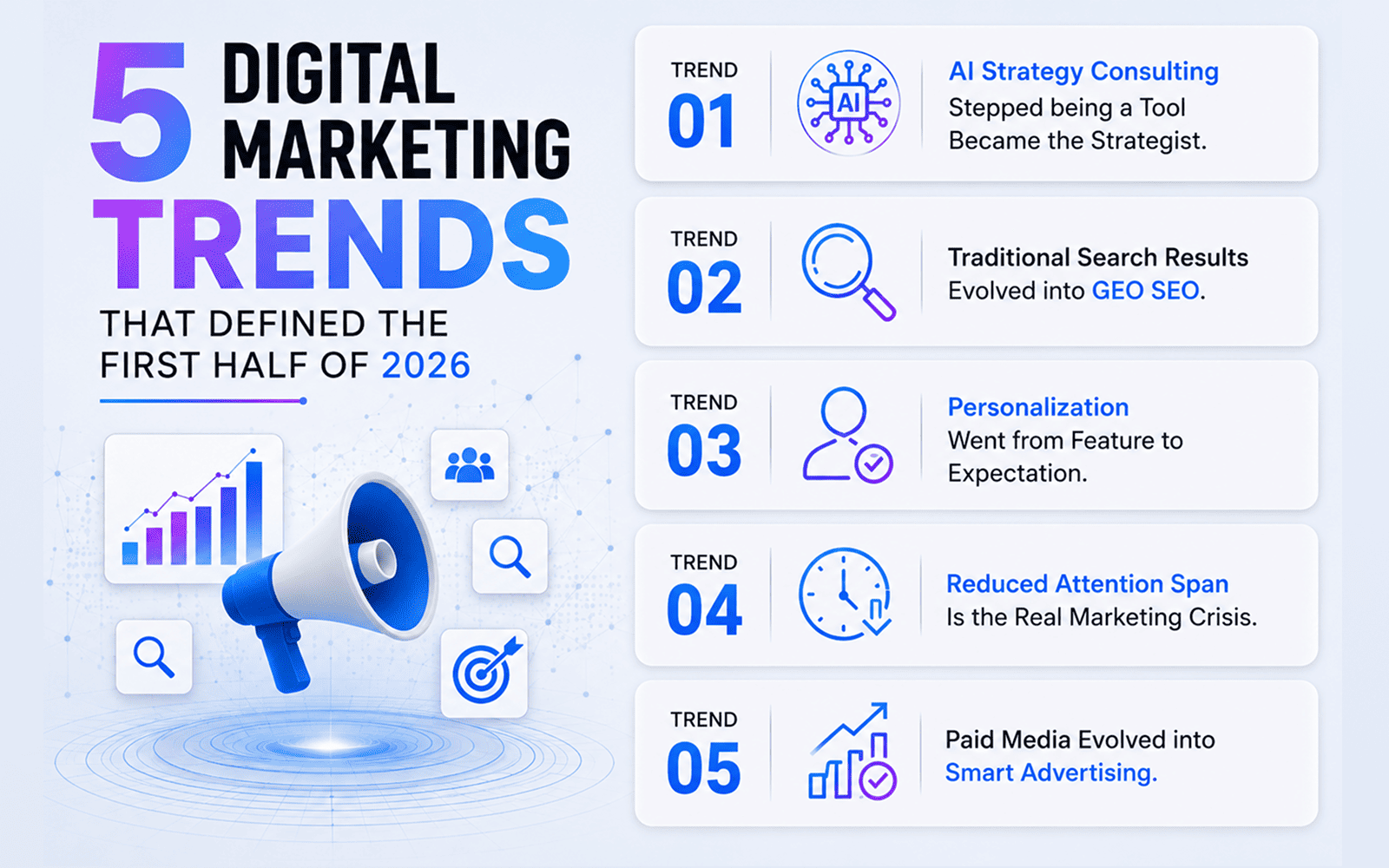
Trend 1 — AI Strategy Consulting Stopped Being a Tool & Became the Strategist
How AI Is Changing Digital Marketing: The Shift from Assistant to Decision-Maker
Not long ago, AI in marketing meant autocomplete and A/B test suggestions. Useful. Peripheral. Easy to ignore. That version of AI is gone. What replaced it operates at a fundamentally different level — analyzing audience behavior in real time, reallocating budget across channels mid-campaign, identifying content angles before a brief is even written. Marketing teams didn't hand AI more responsibility deliberately. It earned it, quietly, by being consistently right. The strategists who embraced this shift didn't lose their jobs — they leveled up. They stopped making decisions AI could make faster and started making decisions only humans can make well. That distinction is now the most important line in any modern marketing org chart.
The brands that handed AI the wheel — and what happened next
The brands that fully integrated AI into their strategic layer didn't just save time. They compounded advantage. Every campaign generated data. Every data point sharpened the next decision. Every sharpened decision widened the gap between them and competitors still running on quarterly gut instinct. For your brand, the question is no longer whether to integrate AI into your marketing strategy — it is whether your strategy is built around AI's actual capabilities or merely decorated with its aesthetics. One compounds. The other costs budget and credibility. The brands that handed AI the wheel didn't abandon strategy. They finally had the bandwidth to think at the level strategy actually demands.
Real examples of AI-led campaign strategy in 2026
Three patterns defined the leaders this year. First, dynamic creative optimization — AI testing hundreds of message variants simultaneously, retiring underperformers within hours, not weeks. Second, predictive audience modeling — campaigns launching already knowing which segments would convert, rather than discovering it after spend. Third, autonomous budget reallocation — platforms shifting investment across channels in real time based on live performance signals, no human approval required. The thread connecting all three: AI wasn't executing a human strategy. It was building and refining strategy continuously, using data no human team could process at that speed or scale. The results weren't marginal. They were structural.
Where human judgment still wins (and always will)
AI is an extraordinary strategist within a defined problem space. It optimizes ruthlessly, patterns brilliantly, and scales without fatigue. What it cannot do is care — about brand integrity, cultural nuance, the feeling a campaign should leave behind. The best marketing decisions of 2026 weren't made by AI or by humans. They were made in the space between: AI surfacing the “what”, humans deciding the “why”. Crisis communication still needs a human voice. Brand positioning still needs human conviction. Creative risk — the kind that builds iconic brands — still needs someone willing to bet on an instinct no algorithm can validate. That space isn't shrinking. For the best marketers, it's expanding.
Trend 2 — Traditional search results evolved into GEO SEO
The rules of search didn't change overnight — they shifted quietly, query by query, until the old playbook stopped working. Keyword optimisation alone no longer moves the needle. AI-driven algorithms now understand the intent behind a query, not just its words. The shift has a name: GEO SEO — where traditional SEO meets Generative Engine Optimisation. Technical foundations still matter — Core Web Vitals and E-E-A-T signals remain non-negotiable. But they are the floor now, not the ceiling. Being discoverable across AI Overviews, ChatGPT, Perplexity, and traditional SERPs simultaneously is no longer forward-thinking. In 2026, it is the baseline.
How AI-powered search completely disrupted SEO as we knew it
AI didn't just change SEO tactics — it changed what the game was. The entire logic of visibility shifted from manipulation of signals to demonstration of authority. In just one year, the number of organizations adopting AI across business functions surged rapidly, with marketing emerging as one of the earliest areas to evolve. Brands focused only on producing high volumes of content without real authority are becoming invisible in AI-driven search results. Meanwhile, companies investing in meaningful insights and authentic expertise are earning citations — and in 2026, being cited by AI is the new version of ranking on page one.
The era of Blue Links is Gone. Here Is What Took Their Place
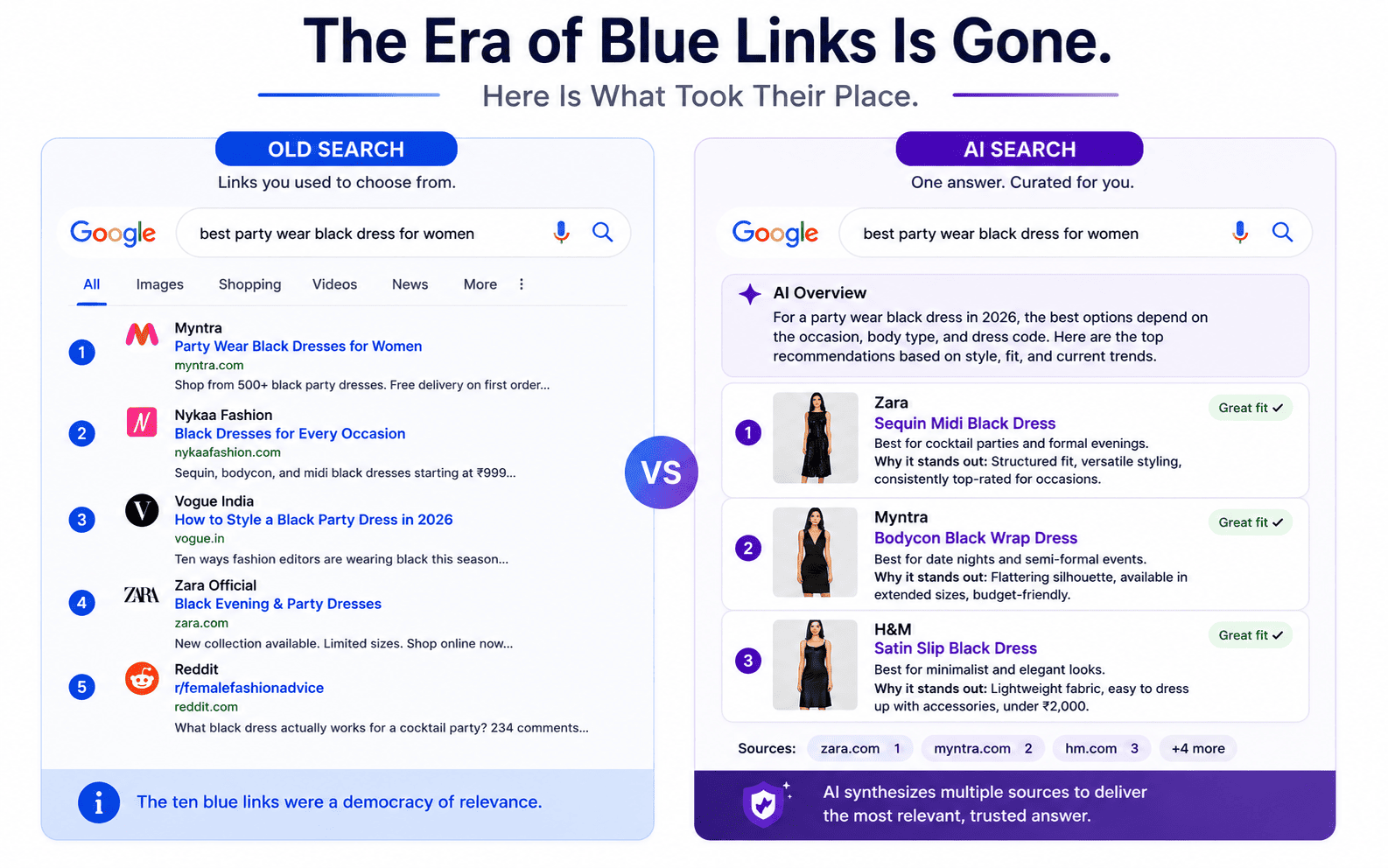
For three decades, search had a reliable shape. You typed. Links appeared. You clicked. That ritual is over. AI-powered search presents answers, not options — synthesising multiple sources into a single authoritative response. The brand that would have earned that visit now either gets cited or doesn't exist in that moment. There is no position six after 5 links. There is cited, and there is invisible. As Cathal Melinn put it — the question is no longer what your customer is searching for. It's what the AI bot is searching for on behalf of your customer. The blue links were a democracy of relevance. What replaced them is a meritocracy of trust — and trust compounds slowly and loses fast.
What content actually ranks in an AI-answer world
Content doesn't rank anymore — it gets cited or ignored. Three things determine which: intent alignment, structural clarity, and first-party data intelligence. Intent means matching the precise purpose behind a query, not just its keywords — and format must match intent too. Structural clarity means answer-first content with clear headings and specific data that AI systems can extract without reading through preamble. First-party data means knowing exactly what your audience needs at each journey stage — the one signal competitors cannot replicate. Intent also evolves. Brands maintaining AI visibility treat content as a living asset — continuously refreshed — not a publishing calendar to fill.
How to optimise for visibility when Google isn't the only gateway
The most dangerous assumption in search strategy today is that Google is the only gateway worth optimising for. ChatGPT, Perplexity, Microsoft Copilot, and voice AI assistants each independently surface answers — on different citation logic, winning across every gateway requires three things: content structured for extraction — clear, factual, answer-first. Brand authority beyond your own domain — through expert mentions, industry citations, and community presence on platforms AI systems pull from heavily. And measurement that goes beyond organic traffic to include AI citation share and zero-click visibility. Search is no longer a channel. It is an ecosystem of AI intermediaries — each deciding independently whether your brand is worth surfacing.
Trend 3 — Personalisation Went from Feature to Expectation
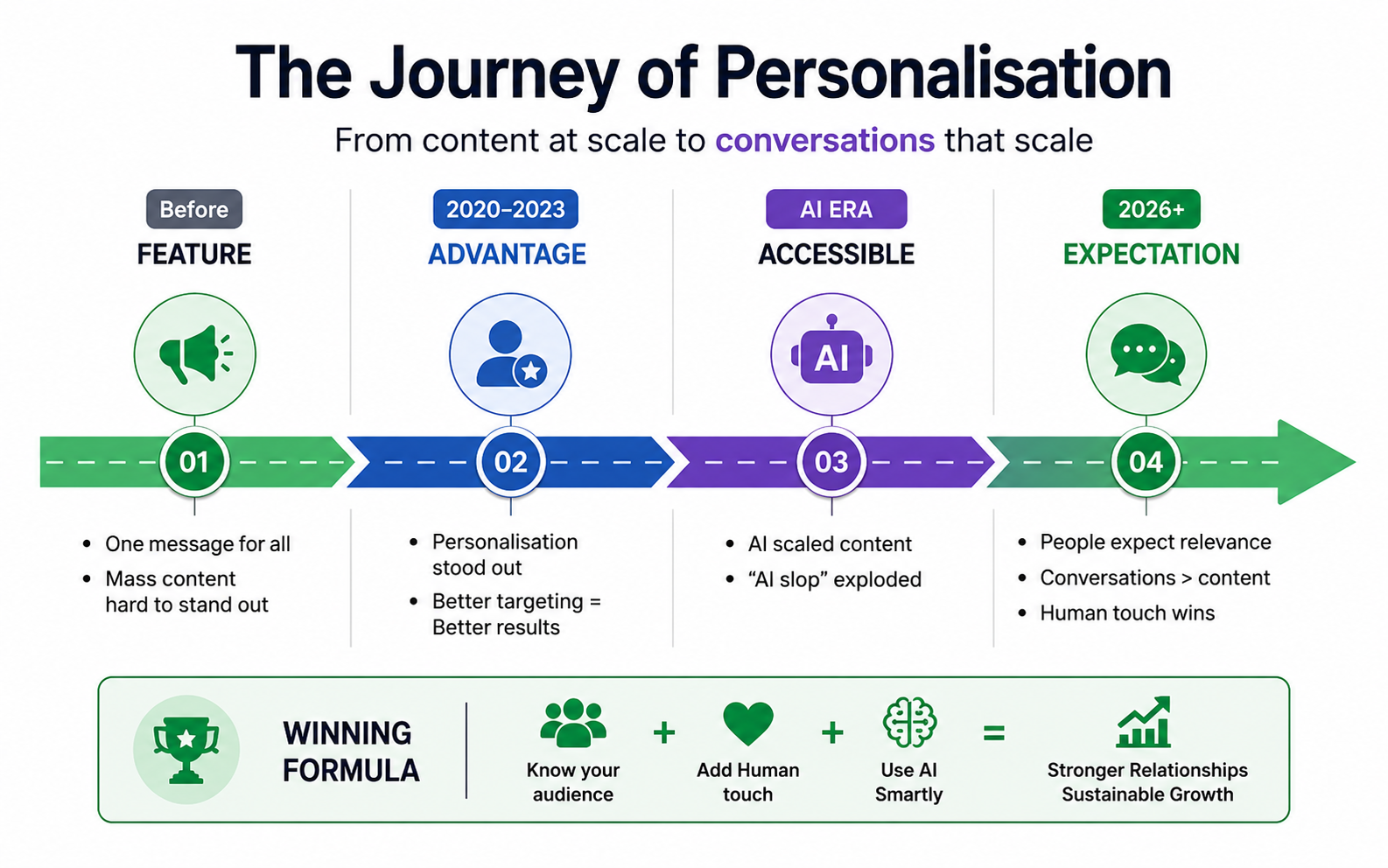
Personalisation used to be a competitive advantage. The brand that remembered your name, anticipated your next purchase, or served the right message at the right moment stood out precisely because most brands couldn't do it consistently. That era is over. AI made personalisation so accessible, so scalable, and so expected that its absence is now the thing customers notice — and penalise. What changed wasn't just the technology. It was the consumer baseline.
Audiences in 2026 don't want content — they want conversations
AI has made it cheaper, faster, and easier than ever to produce content at scale — and simultaneously made that content less valuable than at any point in the last decade. 'AI slop' entered the Cambridge Dictionary in 2025 —refers to low-quality, generic, or meaningless digital content mass-produced by generative AI with little to no human oversight. This was a cultural timestamp marking the moment the internet collectively acknowledged what was happening.
The shift from content consumption to conversational engagement is not a trend layered on top of existing strategy. It is a fundamental reorientation of what audiences expect from brands they choose to spend attention on. They want to be heard, they want responses, they want interactions that feel genuinely tailored to them .
The opportunity this creates is significant precisely because most brands are moving in the opposite direction — producing more, faster, with less human fingerprint on any of it. The brands willing to invest in originality, creative risk, and genuine human voice are not competing in a crowded space. In 2026, the most powerful content strategy is not a content strategy at all. It is a conversation strategy — built around listening as much as publishing, responding as much as broadcasting, and earning attention through genuine value rather than manufactured volume.
How AI made hyper-personalisation accessible for small businesses
Hyper-personalisation was once the exclusive domain of enterprise brands with eight-figure marketing budgets and dedicated data science teams. The infrastructure required to collect behavioral signals, build audience segments, and deliver individually tailored experiences at scale was simply out of reach for smaller operations. AI erased that barrier — not gradually, but almost entirely, and faster than most small business owners realise.
The tools now available to a lean marketing team are functionally comparable to what large organisations were building custom solutions for just three years ago. The capability gap between large and small has narrowed to the point where execution discipline and creative quality matter more than budget size.What small businesses have that enterprise brands often struggle to replicate is authenticity at scale — a genuine voice, a defined community, and the agility to respond to individual customers in ways that feel personal because they are.
The small businesses winning with hyper-personalisation in 2026 are not the ones using the most sophisticated tools. They are the ones who have been clearest about who their customer is, what that customer genuinely needs, and how AI can help them deliver that need more precisely and more consistently than they could alone.
Trend 4 — Reduced Attention Span Is the Real Marketing Crisis
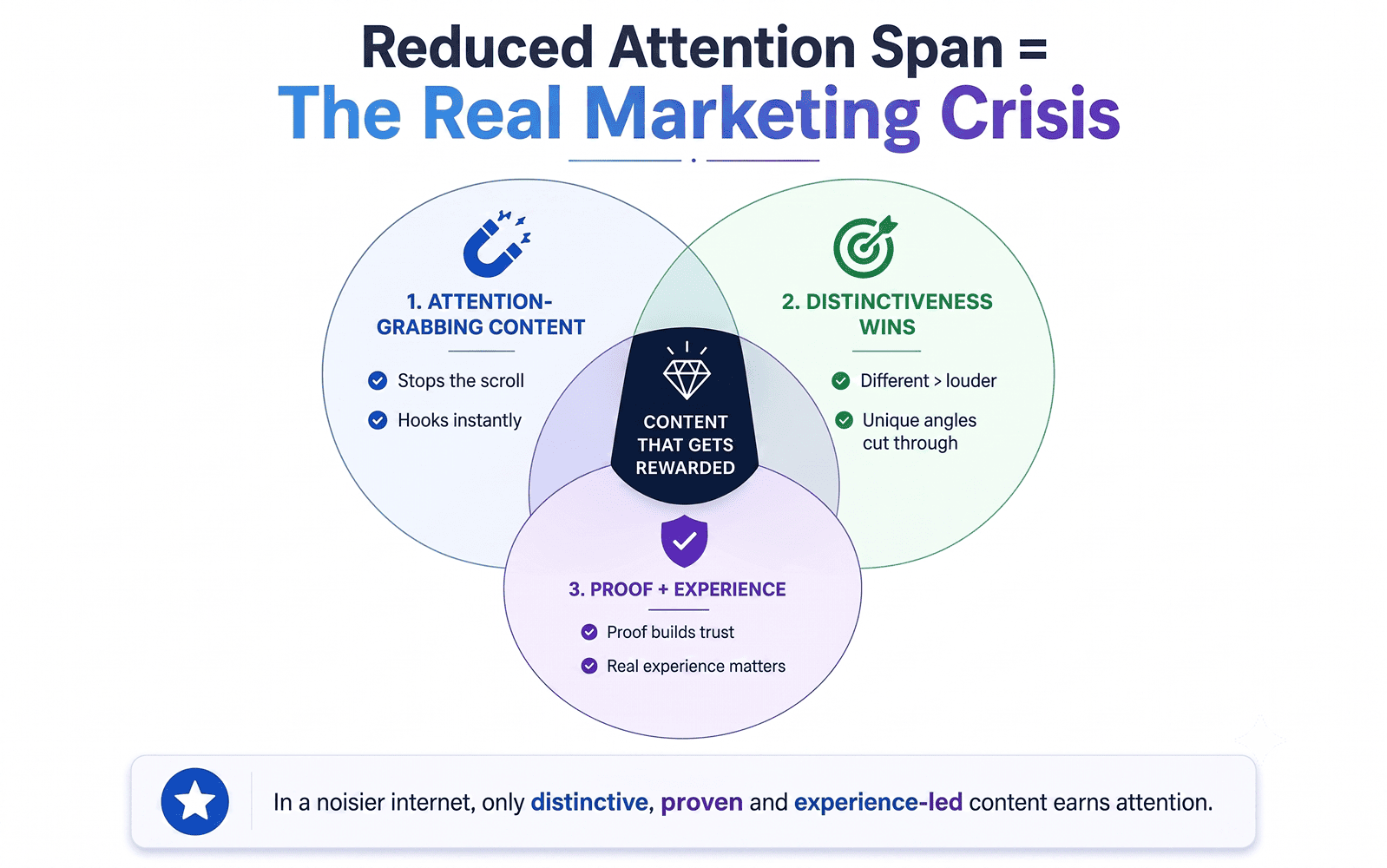
AI democratised content creation overnight. Every brand, every competitor, every solo operator now publishes at scale. The result is not a richer internet — it is a noisier one. Attention didn't keep pace with volume. It contracted. Audiences grew more selective, algorithms grew more discriminating, and the content that once performed on consistency alone stopped earning its place. In 2026, the content problem is not production. Every brand has solved production. The problem is distinctiveness — and most brands haven't solved that yet.
When everyone can create content, what actually cuts through?
Distinctive content. Not louder, not more frequent — different. The brands cutting through in 2026 are those owning specific angles nobody else can replicate: original research, proprietary data, lived experience, and genuine points of view. Think about the topics you are uniquely positioned to speak on. That positioning is your content moat — and in an AI-saturated feed, a moat is the only defence that holds.
The rise of proof-led and experience-led content in 2026
Audiences have developed a sharp instinct for content that was generated without genuine knowledge behind it. They scroll past it. AI search systems are developing the same instinct — prioritising content with verifiable facts, expert attribution, original data, and real-world experience over content that is merely well-structured and fluent. Proof-led content — case studies, original research, cited statistics — signals authority. In 2026, the most effective content combines both. It doesn't just make a claim. It earns belief.
Trend 5 — Paid Media Evolved Into Smart Advertising
AI didn't just optimize paid advertising — it rewired it entirely. Automation is no longer a competitive edge; it's the entry requirement. Meta's platforms are moving toward fully AI-created and targeted advertisements by the end of 2026 — generating personalised ad variations, dynamic image backgrounds, and automated video adjustments at a scale no human creative team can match alone. The brands still running paid media the old way aren't just behind. They're paying more for less.
How AI bidding and targeting changed the ROI game in 2026
Manual bidding strategies didn't lose to AI gradually — they lost decisively. AI-powered bidding systems now process thousands of real-time signals simultaneously — device, behavior, intent, time, competitive landscape — and adjust spend accordingly, within milliseconds. The result is a fundamental shift in where ROI comes from. It no longer comes primarily from who you target. It comes from how intelligently your system responds to live market conditions. Marketers who understood this early restructured their paid strategy around feeding AI systems clean data and strong creatives. Those who didn't are watching their cost-per-acquisition climb with no clear explanation why.
The brands getting priced out — and the ones quietly winning
The smart advertising era created two distinct camps. The first is paying more for diminishing returns — running broad creative, relying on platform defaults, and competing in auction environments where AI-powered competitors consistently outbid and outperform them. The second camp barely advertises loudly at all. They win through precision — hyper-specific audiences, creative tailored to micro-segments, and AI systems trained on rich first-party data that generic competitors simply don't have. The quietest brands in the feed are often the most profitable ones behind the dashboard. In this era, efficiency is the new scale.
New Marketing Strategy or Old Playbook? The Choice Defines 2027
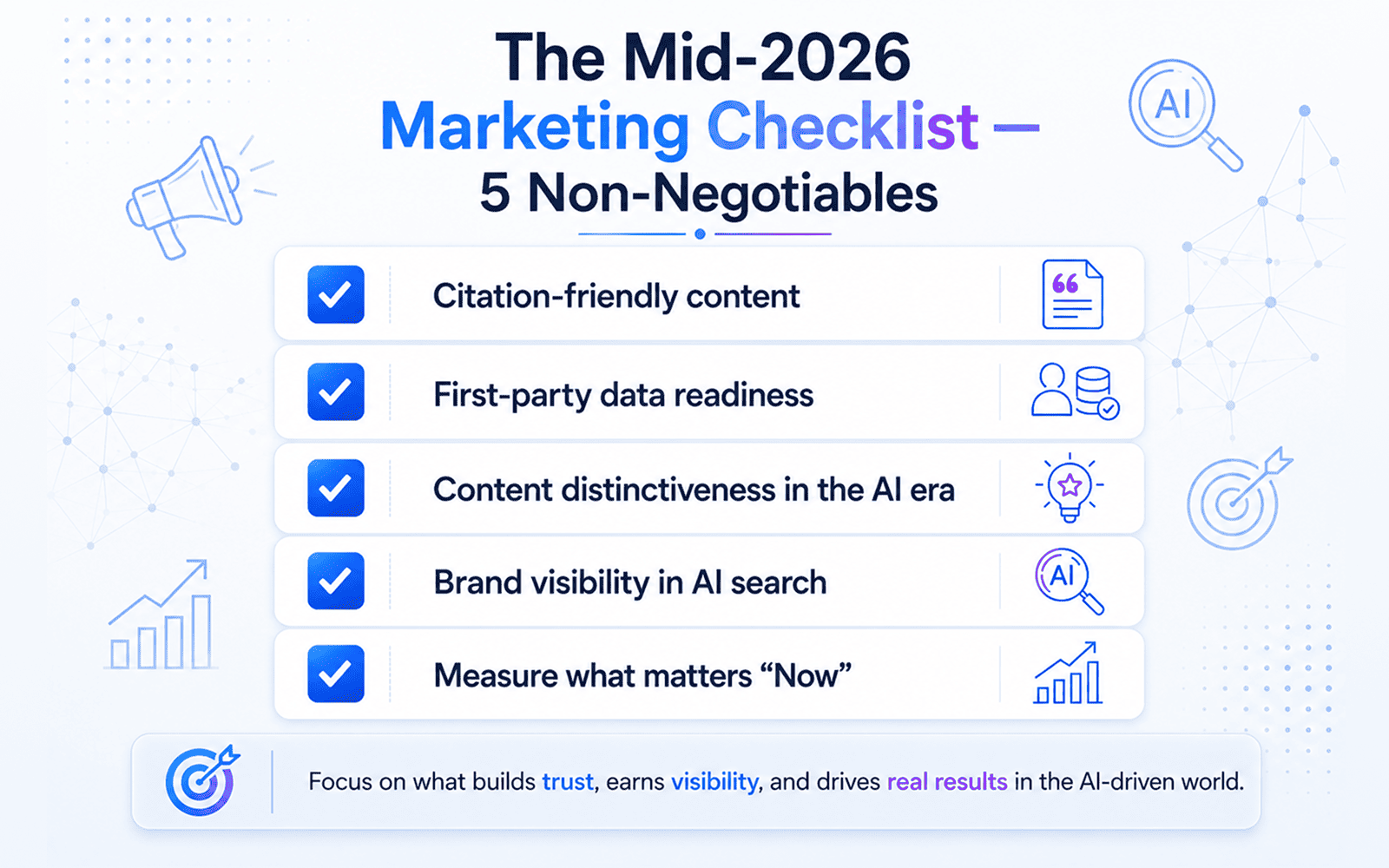
The five questions every marketer needs to answer before Q3
- Is my content built to be cited — or just built to be found?
- Am I feeding my paid media platforms enough first-party data to compete?
- Does my content have a point of view no AI can generate?
- Is my brand visible where AI goes to find trusted answers?
- Am I measuring what still matters — or what used to matter?
What to stop doing immediately in the second half of 2026
- Stop chasing follower counts over genuine influence. Influencer marketing didn't die — it matured. The de-influencer movement exposed what savvy marketers already knew: reach without trust is worthless. Influencer marketing helped social media surpass paid search in 2025 — but the brands winning aren't buying audiences. They're building relationships with creators whose communities actually listen.
- Stop treating influencers and content creators as the same thing. The lines are blurring — deliberately. As Jane McDaid, Founder of Thinkhouse puts it, the creator economy is where influence actually happens now. Unilever is sending 10,000 content creators to the 2026 World Cup. Coca-Cola deployed the same model at the Paris Olympics. These aren't influencer campaigns. They are creator-led brand ecosystems — and the distinction matters strategically.
- Stop underinvesting in PR. AI pulls citations from credible media sources. A single well-placed PR hit now travels further and lives longer than it ever did in traditional search or social. PR has moved upstream — it directly feeds AI visibility, brand authority, and citation likelihood. Treating it as a secondary channel in H2 2026 is leaving one of the highest-compounding assets in marketing chronically underfunded.
- Stop producing content without a distribution strategy built around trust. Volume without credibility is noise. In 2026, every piece of content needs a clear answer to one question before it's published: where will this earn genuine attention — and from whom?
What to double down on before the year ends
- Community over content - without compromise : Social media has evolved again. Broadcasting to audiences is out. Building communities is in. As Alison Battisby puts it — in 2026, brands aren't chasing viral moments or algorithmic reach. Audiences are craving real conversations, real opinions, and real people. The numbers confirm the shift: Reddit overtook TikTok as the UK's fourth most visited social platform with an 88% user increase. Substack hit 5 million paid subscriptions. Discord reached 259 million monthly active users in 2025. These aren't niche platforms anymore. They are where trust is being built — and where AI goes to find credible citations.
- Double down on micro-community presence : The opportunity isn't just on community-first platforms — it's on every platform where genuine conversation happens. WhatsApp brand communities, Instagram broadcast channels, TikTok private spaces. The brands winning aren't posting into feeds. They are participating in conversations — adapting their tone. Pick one community platform where your audience already exists. Go deep there before going wide. Consistency in one space outperforms presence in five.
- Double down on PR as a visibility engine : PR is no longer a brand-building afterthought — it is an AI citation strategy. For small businesses, PR means expert quotes in industry newsletters, guest posts on credible platforms, podcast appearances, and active participation in forums AI systems cite — Reddit, Quora, LinkedIn. Every credible external mention builds citation authority. Start small. Be consistent.
The Rules Changed. Your Move.
The marketers who thrive won't be the ones who predicted AI — they'll be the ones who adapted
The playbook didn't get updated. It got replaced. Every trend covered in this article points to the same conclusion — incremental adjustments to an old strategy won't close the gap that H1 2026 opened. What's required is structural transformation: how marketing connects to revenue, how content earns authority, how audiences are built rather than bought, and how AI is used to elevate work rather than automate mediocrity.
The marketers winning right now aren't the ones who saw AI coming. They're the ones who stopped waiting for certainty and started building for the reality in front of them. They aligned their KPIs to revenue, not vanity. They invested in scalable infrastructure without sacrificing the human voice that makes brands worth following. They understood that in an AI-saturated market, distinctiveness isn't a creative preference — it's a survival requirement.
2026 is not a difficult year to be a marketer. It is the most consequential one. The distance between brands that adapt and brands that don't has never been wider — or faster to compound.
What the second half of 2026 is quietly setting up for 2027
Everything happening in H2 2026 is infrastructure for 2027. The brands building community presence now are accumulating trust that paid media cannot buy later. The ones investing in GEO SEO authority today are building citation networks that will compound through every algorithm update ahead. The ones using AI to produce better work — not just more work — are developing creative capabilities that will define their category positioning going into next year.
2027 will not reward the brands that reacted fastest to individual trends. It will reward the ones that built systems — for content authority, audience trust, paid media intelligence, and personalisation at scale — while others were still debating whether the change was real.
The change is real. The window to build ahead of it is H2 2026. That window is open now — but it will not stay open indefinitely. The brands with a digital marketing strategy built for this moment will not just survive the transition. They will own what comes after it.
Ready to Adapt — But Not Sure Where to Start?
The brands navigating this transition most successfully aren't doing it alone. In the new AI age of marketing, working with a specialist digital marketing agency isn't just convenient — it is strategically more valuable than at any point before.
An agency that genuinely understands AI-era marketing doesn't just execute campaigns. It builds the infrastructure your brand needs to remain visible, relevant, and competitive as the rules continue to evolve.The skills needed for digital marketing in 2026 are no longer static — they shift with every algorithm update, every platform change, and every new AI capability that enters the market. A specialist agency carries that burden continuously, so your team doesn't have to.
It's high time you stop reacting and start leading — and smart advertising is where it begins. Work with a digital marketing agency built for the age of AI. One that doesn't just follow trends — it helps you stay ahead of them.
Get in touch with our team for expert digital marketing solutions !
Frequently Asked Questions
What are the biggest digital marketing trends businesses need to watch in 2026–2027?
The biggest shifts are AI-led decision-making in campaigns, GEO SEO (being cited by AI search tools like ChatGPT and Perplexity, not just ranking on Google), and a move toward community-driven platforms over broadcast content. Both US and Indian brands are seeing search and social behavior shift toward AI-mediated discovery.
How is AI changing digital marketing for small and mid-sized businesses?
AI has made hyper-personalization, predictive targeting, and real-time ad optimization accessible to smaller teams — capabilities that used to require enterprise budgets. For growing businesses in markets like the US and India, this means competing on strategy and creativity rather than ad spend alone.
What skills do marketers need to stay relevant in an AI-driven landscape?
Beyond traditional content and campaign skills, marketers now need to understand AI strategy consulting, prompt-level content structuring for AI search visibility and data-driven decision-making — while still owning the human judgment AI can't replicate, like brand voice and cultural nuance.
How much does it cost to build a new marketing strategy around AI and GEO SEO?
Costs vary depending on your business size, current digital maturity, and how much of your strategy — content, paid media, technical SEO — needs to be rebuilt versus refined. It's best to get a tailored assessment based on your specific goals rather than rely on a generic industry number.
Why is reduced attention span becoming a bigger challenge than content volume?
Since AI has made content production effortless for everyone, audiences are more selective, not less exposed. Businesses in high-competition markets like the US and India are finding that distinctiveness — original data, real expertise, genuine perspective — now matters more than how much content is published.

